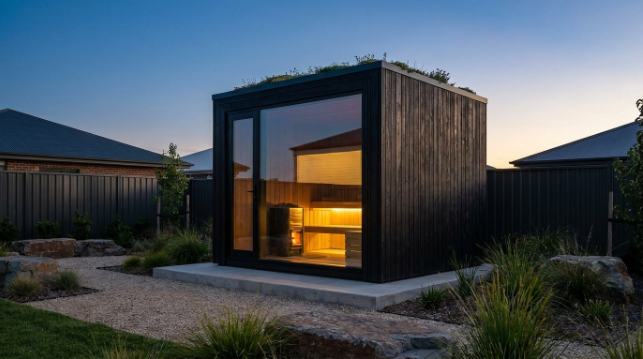
Yes, in nearly every case. Cube sauna heaters typically run 6 to 8 kilowatts to bring an insulated panel-and-glass structure up to 170 to 190 degrees, and heaters at that output require a dedicated 240-volt circuit rather than a standard 120V household outlet. The flat panel construction and glass front common to cube designs do not change this requirement, since it is the heater’s rating, not the wall material, that determines the electrical need.
Does a Cube Sauna Need 240V?
Almost always, yes. A 4-person cube sauna, roughly 6 by 6 feet on the interior with a floor-to-ceiling glass front, commonly ships with a 6 to 8 kilowatt electric heater. Any heater above roughly 4.5 to 5 kilowatts needs 240V to run efficiently, and cube units rarely fall below that threshold because the glass front and flat panel geometry need enough heater output to hold temperature evenly across the whole enclosure.
What Size Heater Do Cube Saunas Typically Use?
Heater sizing tracks interior cubic footage, factoring in the extra heat loss from a glass panel compared with a fully insulated wall. A compact 4-person cube commonly uses a 6 kilowatt heater as a baseline, with 7.5 or 8 kilowatt options available for larger cubes or colder climates where the heater needs more headroom to recover quickly after the door opens.
How Many Amps Does the Circuit Need to Handle?
A 6 kilowatt heater at 240V draws roughly 25 amps, which typically calls for a dedicated 30-amp double-pole breaker and appropriately sized wire gauge for the run length. An 8 kilowatt heater draws closer to 33 amps and generally needs a 40-amp breaker. These numbers come directly off the heater’s nameplate, so confirming the exact model’s rating before the electrician quotes the job avoids a mismatch between the panel and the heater.
Can an Electrician Run Power to a Cube Sauna in a Small Yard?
Yes, this is a standard outdoor electrical job. A licensed electrician typically runs outdoor-rated cable or conduit from the panel to a weatherproof disconnect switch mounted within sight of the cube, with GFCI protection as required by local code. Distance from the panel matters more for cost than the sauna’s shape does, so a cube tucked close to the house in a small yard is often cheaper to wire than the same unit placed at the back of a large lot.
What Does the Electrical Work Typically Cost?
A straightforward outdoor 240V run, including the disconnect switch and GFCI protection, commonly falls between $800 and $2,500 depending on distance and local labor rates. Buyers comparing heater kilowatt ratings across cube models before getting an electrician’s quote can check specs listed in the SweatDecks catalog, since knowing the exact draw ahead of time makes for a more accurate quote than guessing at heater size.
Are There 120V Cube Sauna Options?
A few smaller infrared cube-style cabins run on 120V, but traditional heat cube saunas with stones, built for the 170 to 190 degree range, almost universally need 240V because of the heater output required. If a 120V option is a hard requirement for your electrical setup, it is worth confirming that upfront rather than assuming any cube sauna will fit a standard outlet.
Do You Need a Permit for the Wiring?
In most jurisdictions, yes, a new 240V circuit needs an electrical permit regardless of how small the project looks on paper. A licensed electrician typically handles the permit application and schedules the required inspection as part of the job, so this rarely becomes extra work for the homeowner, but it is worth confirming the quote includes those fees rather than assuming they are bundled in automatically. Skipping the permit to save time or money is a common shortcut that can cause real problems later, particularly around insurance claims or a home sale, where unpermitted electrical work is one of the first things a buyer’s inspector flags.
It is also worth asking about setback requirements for exterior electrical equipment near a property line, since a cube sauna’s compact footprint often puts it closer to a fence or boundary than a larger structure would sit. This is a separate check from the wiring itself, but it belongs in the same conversation with the electrician before any pad or gravel base goes in.
How Is This Different From Wiring a Standard 120V Outdoor Outlet?
A standard outdoor 120V outlet, the kind used for string lights or a pressure washer, is a much smaller job than what a cube sauna heater needs, and conflating the two is a common source of confusion for first-time buyers. A 120V outlet typically runs on a 15 or 20-amp circuit using standard non-metallic cable, while a cube sauna heater at 6 to 8 kilowatts needs a dedicated 240V circuit with two hot legs, heavier gauge wire, and a larger breaker, plus the disconnect switch and ground-fault protection discussed above. The labor and material cost reflects that difference; a simple 120V outlet addition might run a few hundred dollars, while the dedicated 240V circuit a cube sauna needs is a meaningfully bigger project even before accounting for outdoor-rated conduit and a longer run to the panel.
This distinction matters most when getting quotes, since asking generically for “an outdoor outlet” can lead to a mismatched quote if the electrician assumes a small 120V job rather than the 240V circuit the heater’s nameplate actually requires. Bringing the heater’s exact kilowatt and voltage rating, along with the manufacturer’s installation manual if one is available, to the first conversation avoids that mismatch entirely and generally results in a faster, more accurate quote from the start.
Frequently Asked Questions
Do cube saunas need a 240V circuit? Most do. Cube sauna heaters typically run 6 to 8 kilowatts, which requires a dedicated 240V circuit rather than a standard household outlet.
What amperage breaker does a cube sauna heater need? A 6 kilowatt heater draws roughly 25 amps and commonly uses a 30-amp breaker. An 8 kilowatt heater draws closer to 33 amps and typically needs a 40-amp breaker.
Does the glass front on a cube sauna affect the wiring needed? Not directly. The heater’s kilowatt rating, not the wall material, determines circuit size, though the glass does make the heater work slightly harder.
How much does it cost to wire a cube sauna for 240V? A typical outdoor run with a disconnect switch and GFCI protection costs $800 to $2,500, depending on distance from the panel.
References
- Cardiovascular and Other Health Benefits of Sauna Bathing: A Review of the Evidence, Mayo Clinic Proceedings, 2018
- Does the Combination of Finnish Sauna Bathing and Other Lifestyle Factors Confer Additional Health Benefits? A Review of the Evidence, Mayo Clinic Proceedings, 2023
- Effects of heat and cold on health, with special reference to Finnish sauna bathing, American Journal of Physiology, 2018
By Naomi Castell